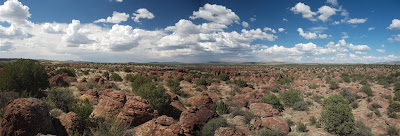
When most people hear "Arizona," they probably think of cacti and desert - a friend of mine calls it "kitty-litter land," in reference to a remark uttered by a Briton upon landing in the southwest: "It's wall-to-wall kitty litter!" While Phoenix certainly fits this description, the area around Prescott is much prettier with much more varied vegetation.
 That said, there are right many cacti. Of particular note is the century plant, which abounds on the ranch. If you've never seen one of these things up close, it's hard to imagine just how tough they are: they say that if you step on one, the central spike will drive through the bottom of your shoe. I can believe it - these things look like they ought to be soft, but are rock-hard. Indeed, they're something of a problem on the ranch. While the cattle and horses typically avoid the plants, either may step on one when a mounted cowboy is chasing a cow - and the results are disastrous. Not only are those spines sharp, but they also secrete an enzyme that enters the puncture and significantly retards healing. Not nice at all.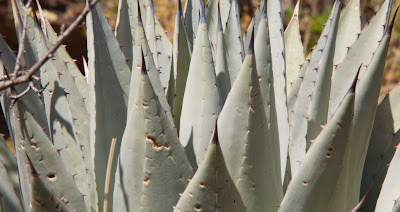
 And, unsurprisingly, they spread. After the plant reaches maturity, they send up colossal stalks topped with flowers that develop seed pods. These several-meter-tall, bamboo-like stalks enable the plant to scatter seeds over a fair distance - not too far, but far enough. The result, after time, is large patches of century plants, amongst which the cattle and horses can't graze, around which a periphery of smaller plants hide amongst rocks, as though lying in wait for the unsuspecting horse or cow. Or person. The ranch handymen try to get to the stalks early in development with machetes, lopping them off before they can go to seed - but there are so many of them over so much land, it's just not possible to get them all.
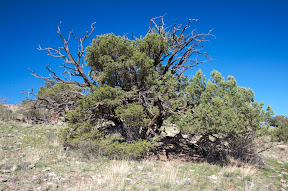 Another troublesome plant is the ubiquitous juniper. While not as dangerous as the century plant, the juniper causes problems by drawing an enormous amount of moisture out of the ground - moisture that, then, can't be used by the grass. As a result, around the base of nearly every older juniper is a bare patch of ground, where the grass has died out. In isolation, this effect isn't terribly problematic - but like all plants, the juniper spreads. After time, they can take over acres of field - and that's acres that can't be used for grazing. But they are pretty, in a wild sort of way. The action of the wind and dryness and, often, survived lightening strikes seems to carve them into fantastic shapes. And on a hike on a hot day, the shade under their branches is most welcome.
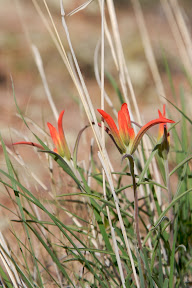
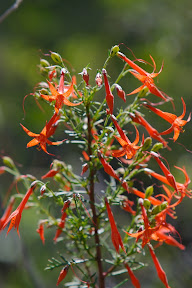
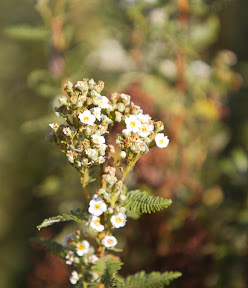 There are also right many wildflowers on the ranch. Perhaps not so many as you see in the East - but then, we were there in summer, and even in the East, there are many fewer wildflowers in summer as compared to spring. Yellows and oranges seemed the most common colors, but there were blues and purples as well, and whites. The terrain and elevation on the ranch is so varied, as is the ready availability of water, that a huge variety of plants are represented. These flowers came from the dryer, higher elevations, where we spent most of our time on the ranch.
 |  |